Four limbs.
One thought.
Coordination is trained in layers. Simple patterns become automatic, leaving your attention free to listen and react.
Drum classes for children in Chennai and online. The body learns first: lock the pulse, separate the limbs, and turn raw energy into a groove everybody else can trust.
Coordination is trained in layers. Simple patterns become automatic, leaving your attention free to listen and react.
Placement, dynamics and consistency turn a beat from correct into irresistible. The metronome becomes a partner, not a judge.
Rock, pop, funk and contemporary repertoire become the laboratory. Rockschool grades provide a route from Debut to Grade 8.
A groove is a relationship between repeating events, not a pile of hits. Choose a feel to reorganise the orbit: straight subdivisions lock into equal space, swing leans, three rotates the phrase, and five makes the bar feel newly balanced.
Straight four: kick and snare anchor equal subdivisions while the hi-hat makes the space between them audible.
Beginners learn safe setup, rebound, counting, basic notation and grooves that coordinate kick, snare and hi-hat without unnecessary tension.
FOUNDATIONEighth- and sixteenth-note feels, fills, crashes, dynamics and song form create dependable performances across rock and pop repertoire.
DEVELOPINGGhost notes, syncopation, triplets, linear phrasing, rudimental orchestration and style studies expand control into funk, blues and contemporary vocabulary.
FLUENCYAdvanced learners refine time, touch, chart reading, odd metres, improvisation and full-set stamina. Rockschool Debut through Grade 8 can formalise progress.
PERFORMANCEA lesson begins with sound and movement: a groove, fill or song section reveals the next useful skill. Teacher and learner reduce it to a countable layer, check grip and motion, then rebuild the pattern around a steady pulse.
The last run is musical and uninterrupted. Students practise cueing a transition, recovering after a slip and controlling volume—skills that matter in a band but rarely appear in an isolated exercise.
Not necessarily. A practice pad or electronic kit with headphones can support much of the work. Acoustic practice needs agreed hours, hearing protection and thoughtful room placement.
No. Early stick control, counting and coordination can begin on a pad. Regular kit access becomes important as foot technique, balance and sound choice develop.
Yes, alongside listening, imitation and song charts. Drum notation is visual and practical; it helps learners remember parts and communicate without replacing the ear.
Yes. Songs teach structure, endurance, dynamics and recovery. Parts can be simplified while preserving the groove, then expanded as control improves.
Yes, especially with an electronic kit or quiet practice setup. Two useful camera angles and clear audio help; studio lessons remain valuable for detailed acoustic sound and equipment experience.
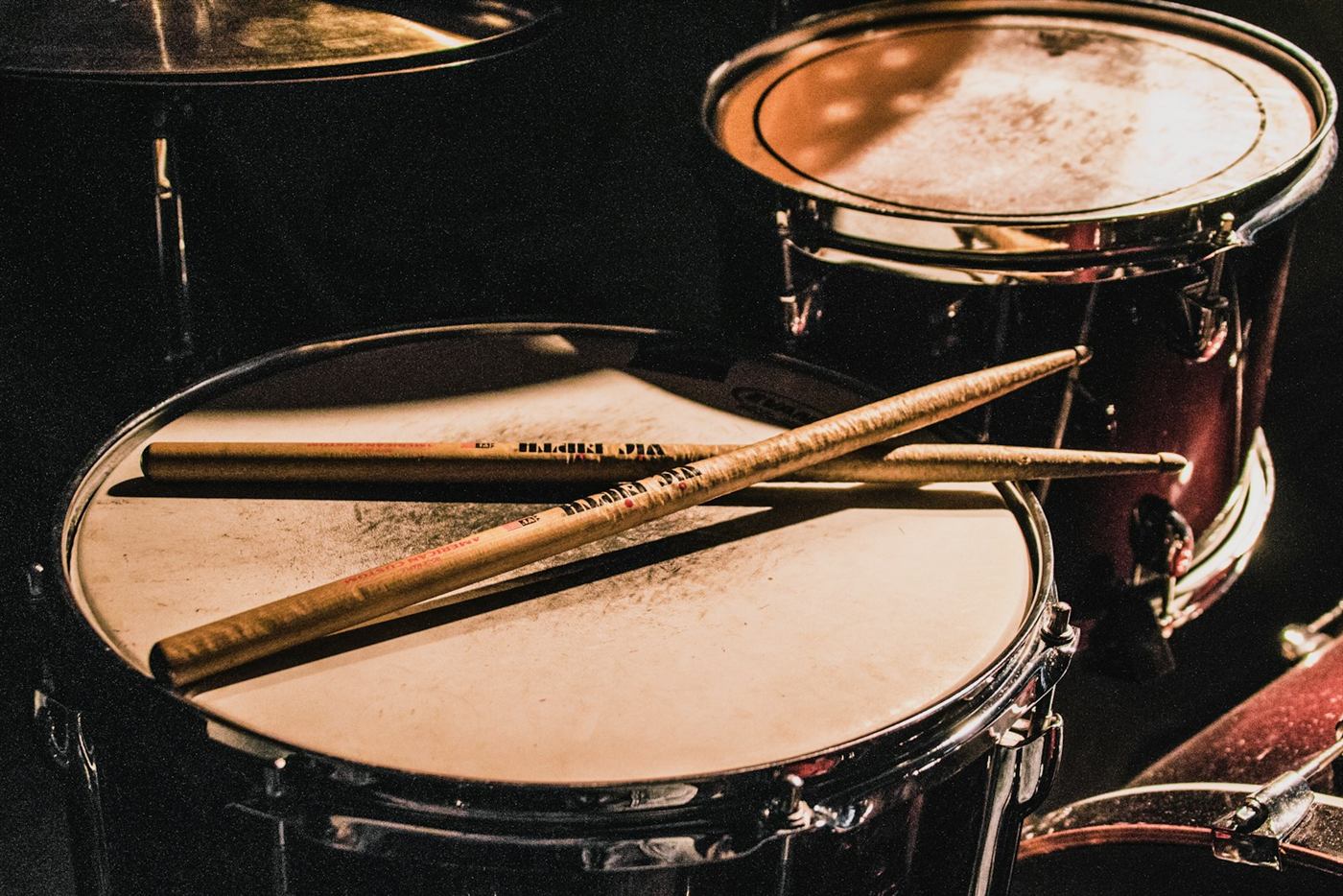
Purpose-built lessons in Chennai studios. Bring your favourite tracks; leave with a way to play them.
Book a free drum trial ↗